Showing posts with label Card Game. Show all posts

Friday, 19 September 2014

37. 'Cards Against Humanity (UK) un-boxing and review. The Cardboard Cartographer issue 12.


Welcome to issue 12 of The Cardboard Cartographer here on The science of selling yourself short.

A whole month since the last issue! Well, if you would like to see what I've been up to in that time head over to The Underhive Hero

In this issue we are not only un-boxing Cards Against Humanity (CAH) (UK edition), but because there isn't a great deal to look at, we'll also be reviewing it too. I know right!

Google-fu.
Wikipedia;


Cards Against Humanity is a multiplayer party game available in published hardcopy via purchase and as a free download that players can print off to create their own cards via print shops. Its development originated from a successful Kickstarter campaign and has since received nationwide acclaim for its simple concept backed up by its satirical, mature content

Cards Against humanity is a game that was hugely successful on Kickstarter.
I'd go as far to say that it was on of the first board game type projects to gain such notoriety and continued popularity after the campaign had ended.
Since then it has become a force in its own right, with even those who are not traditional gamers getting involved and loving it.

I must admit that I did not discover Cards Against humanity until long after the end of the Kickstarter campaign, so my knowledge of this game comes post Kickstarter.

If you want more information I suggest heading over to the CAH website. You can download a print and play edition of the core game for free! - http://cardsagainsthumanity.com/


Lets get started shall we?


In this issue we're just looking at the core game, and here it is;

As you can see, the box (black with white text) and rule book (white with black text) are very clean, very simple. This is a design feature throughout the game.

The only other items in the box? Cards. Lots of cards.


Again, these are split into two colour schemes.
The black cards have a statement/question/situation printed on them, while the white cards have an 'answer' printed on them.


That is literally it. 

First Impressions.


Design wise it is minimalist to the extreme; simple, plain, clean but clear and contrasting. It isn't visually exciting or pleasing, but then it isn't terribly dull or offensive either.
The card stock is pretty flimsy, and as a party game which will see a fair amount of handleing this is a bit of an issue, and there are far too many cards to use sleeves on.

I like a bit of colour and artistic licence in my games, but in the case of CAH I think simple is better.


Gamplay.


CAH is a tad fast and loose when it comes to rules.
The basic rules are as follows.

Each player is dealt ten face down white cards.

A 'card-tsar' is selected (insert arbitrary 'first player mechanic here').
The card-tasr then deals a face up black card for everyone to see.
All other players then pick one of their white cards to 'answer' the black card.
The card-tsar then shuffles them and deals them face up, reading the black card and then the white card each time.
The card-tsar then decides which white card is the funniest.
The player who played that card takes the black card.
All players draw back up to ten (some cards require multiple cards for the answer).
The role of card-tsar then passes clock wise.
The game ends when there are no more black cards left/ you get board/ a pre-set number is reached.

That is it.

There are a bunch of rules that can be thrown in for added complexity/ variety, but how many you use, or don't is entirely up to the players.


Personal Opinion.

While on the face of it CAH's game mechanics sounds unbelivably simple and repetative (they totally are by the way), the game itself is outrageously enjoyable, so long as you are not easily offended.

What makes this game so outstanding is humour.
CAH uses a shock and awe tactic when it comes to the answer given. Some answers are tame, some morbidly realistic, while others are gonzo and/or offensive as possible (I for one was not slightly bothered. I have a high redolence when it comes to this type of humour).

This is not a game to be taken seriously. In any way.

However its simplicity does allow for a the 'player behaviour' mechanic to flourish.
This is a mechanic not always written into the game; it forms naturally as a result of empty space.'
In CAH this takes the form of strategic answers, or in others words, knowing how to make certain people laugh.

For example; Some people find gonzo humour funny. If the card-tsar is one of these people, you aim to play an answer that fits in line with their sense of humour.
While on the other hand, if the card-tsar is not into that type of comedy, you simply play something else.
So while the game isn't serious, nor is it based on tactics or skill, there is still a little room for intelligent play...
...but only a little.

Overall, I enjoyed the game. I am blessed with a group of friends who are not easily offended and have a similar sense of humour as I do.
The game has obvious drawbacks;
If allowed to go on for too long it gets very, very repetitive. There are 5 expansion out (accurate at time of publication).
Also if played with the wrong people it just will not be any fun,so be careful (100% NSFW).


Digital Spotlight.


Nope. There are no official digital editions of CAH (other than the print and play pdf).

However, their website states;
'
Cards Against Humanity is available under a Creative Commons BY-NC-SA 2.0 license. That means you can use, remix, and share the game for free, but you can’t sell it without our permission. Please do not steal our name or we will smash you.'
A such there are so very many in browser and app versions of this game (even more than coin age).
I haven't played any of them as they all vary in quality/ malaware.
Some have online matchmaking which is potentially hilarious...

I feel that CAH isn't about that though. It is a more intimate, party setting game. Take that away and it loses its soul and character.
That might just be me.


That is all for this, very text heavy, issue of The Cardboard Cartographer!

What do you think of Cards Against Humanity?
Have you played any web or app based versions?
What is the best card combinations you've had?

Feel free to comment on this post or hit me up on Twitter @DarKHaZZl3

Until next time, thanks for reading.

-DH-

Tuesday, 19 August 2014

36. 'Elevenses; The Card Game of Morning Tea.' un-boxing. The Cradboard Cartographer issue 11.


Welcome to issue 11 of The Cardboard Cartographer here on The science of selling yourself short.

This issue sees us un-boxing yet another very new game; Elevenses; The Card Game of Morning Tea.


Elevenses; made by Adventureland Games,  was another indie game that managed to secure the funding it needed via kicktsarter. It had an original funding goal of $5,000 AUD and finished it's campaign on $26,535 on December 16th 2013. If you want to check the campaign out head over to their Kickstarter page here.

Another game I have yet to play (this is becoming a habit).
Elevenses is essentially a power driven card game.
The object of the game is to obtain the 'most scrumptious spread' of snacks and beverages in order to have the valuable morning tea by the end of the round.

On to the un-boxing!

This isn't a 'bix box' game. It is quite a neat and compact little game, which is part of the reason I backed it.
When you unpack it though....


There seems a fair amount of content for such a small box!
In addition to the several types of card (we'll come back to those), there is a metallic bell and a set of 30 wooden cubes.
The wooden cubes, or 'sugar cubes' are painted white, and used to keep score. Very minimalistic.
The Bell is cool and was a Kickstarter Backer exclusive reward. It has literally no function in the game though, so if you didn't manage to back this game, have no fear.

Anyway, on to the rest of the game.


There are 44 Morning Teat Cards, four sets of 11 for each player. These have different coloured backs. Each card has various information relating to the game (the position on the 'spread,' the value, the cards power and some flavour text).
I love the watercolour artwork. It is very artsy and quite cute. It is nice to see something different in card design. The pastel colour set is refreshing, and theme that continues throughout.

As well as the Morning Tea Cards their are 6 Special Guest Cards.


These are used with the advanced rules. They are essentially bonus points to add to your spread once you have acquired the items indicated on their card.

Finally there are the player aids


These cards are; the Summary cards (left and bottom middle),
the Sugar Bowl Card (top middle),
and the Starting server (right).

None of these are essential, they are just their to remind players of the positions of cards in the morning tea, to show how many points are available and to indicate the starting player in a round.


And there you have it.

The cards are really lovely. Clean, clear and simple, but with an artistic twist. It just goes to show that you can have function and great visuals without compromising on either part.
The pastel colours are a great touch too. I love bold colours, but it is nice to see someone do something different for a change.

I really think the colour pallet suits the game.
I can't wait to make some tea!


That is all for this issue.
Have you played Elevenses? What did you think about it?
What other Kickstarter board/card/RP games have you backed/played?If you want to get in touch the please feel free to comment of hit me up @DarKHaZZl3 on twitter.
I'd love to hear from you.

Thanks for reading. Until next time.

-DH-


Monday, 11 August 2014

34. 'Pandanté' un-bxoing. The Cardboard Cartograhper issue 9.


Welcome to issue nine of 'The Cardboard Cartographer' here on 'The science of selling yourself short.'

In this issue I'm very excited to be un-boxing another brand new game; Pandante!


  Now Pandanté is a very new and relatively unknown game.
Pandanté is a game by Sirlin games that was funded on kickstarter. It reached its goal and was marked off as funded on December 20th 2013. It managed to beat the original funding goal by over $20,000, which is quite impressive!

If you want to check out the Kick-starter's campaign page you can here. There is also an option to print out a copy to play it! - Pandanté Kickstarter Page

Pandanté is essentially a poker based game with variable powers; throw in some cheating and misdirection here and there., and boom! Pandanté.

 I have yet to play it, which is a shame. This is just an un-boxing.
The review will appear in a future issue, so keep your eyes peeled!

In the meantime if you want to check out how it has fared with the board gaming community you can check it out on Board Game Geek - http://boardgamegeek.com/boardgame/140163/pandante


Let's get started shall we?

There are several editions of Pandanté available. This one is the standard version (with a couple of the kickstarter backer exclusives thrown in).


So once the box is unpacked you can see that there isn't a massive amount of parts to punch out or anything like that.
Simply the rules, a dealer chip, some reference sheets, the cards and those kickstarter backer rewards.

The rule book is simple, clear and that is about it.


Moving on!
Reference sheets.


 The reference sheets are clear, organised, very simple and fairly big (they have to be for the game to function properly).
No complaints here.
It is a bit plain, but when it comes to reference sheets I feel this is a plus point.
The only possible down side here is that they are made of cardboard composite. I have a bit of a pet hate for that material as they always get damaged. These seem fairly durable however, and quite thick, so it should not be a problem.

Dealer Chip.


The dealer chip is also made of cardboard composite. This however feels thinner and somewhat cheaper, I almost bent it getting it out of the box. It is also a little plain.
Unlike the reference sheet I think that cardboard composite was a poor choice for this. The dealer chip will be handled a fair amount. Durability should have been a key concern.
It isn't the most important piece in the box; almost anything can be a dealer chip, but it just feels a little lazy.

On to the main event. The Cards.


In Pandanté there are several types of cards.
We'll start with the colours.


These fill the role of suits in Pandante; in addition each colour has a power.
I love the colours. Big, big fan of the brightness. They are also plastic coated, very high quality. They need to be really. They are also really big; probably about 5 inches high. I don't think they need to be so big, but it does add some character to the game, so I'm actually quite fond of it.


Then there are the Panda lords.


There is a Panda lord for each colour.
Like the colour they match, Panda lords have additional powers.
They're again, very colourful, very simple and clear. Very pleasing overall.

 
Joker.


 I LOVE IT. 

 
There are also challenge cards.


As this is a game of lying/cheating/bluffing, players have the ability to 'challenge their opponents' bluff. These cards allow you to challenge your opponent, without revealing the whole card.
A simple, clear, rules based card.
Everything you need it to be. No complaints.
 

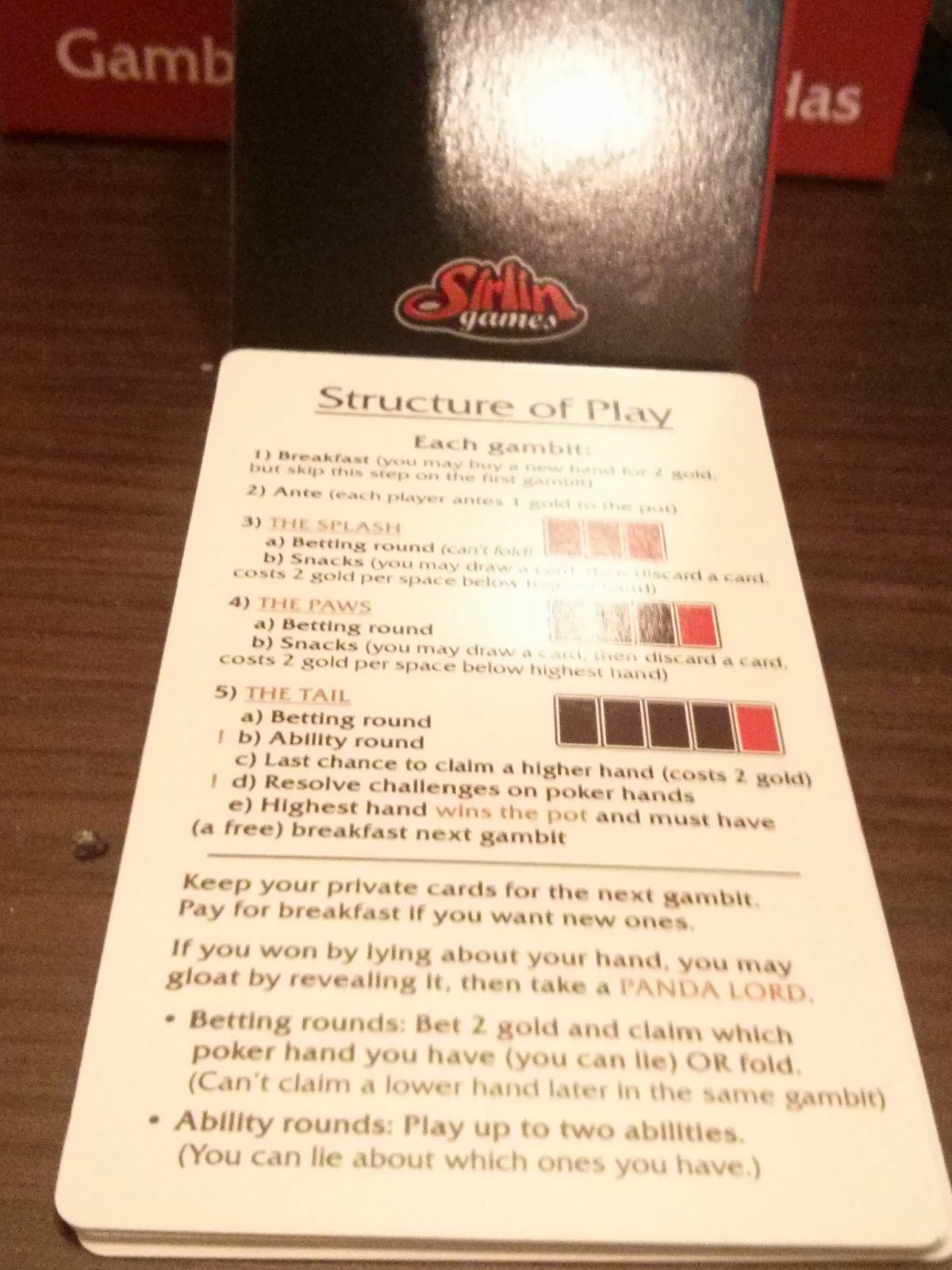
Structure of Play cards.


Like all good card games (that aren't wholly based on 'in game card rules' like Munchkin, fluxx and so on) Pandante comes with a structure of play card; a quick reference sheet on how the game plays out. There is enough for each player to have their own. Perfect.


Kickstarter Backer only rewards. 


I love and hate backer only rewards.
They are awesome if you're a backer, but if you're late to the party you miss out on them, which is a great shame.
The cards here are mainly to be switched with cards already in the core game, so it doesn't matter too much.
The purple card however has its own abilities. As does the alternate Orange Panda Lord.


The cards look pretty damn good.


There you have it!
I'm really looking forward to playing this.
If I'm honest I wish I had backed the deluxe edition which comes with high quality clay chips. It would have been nice to have the whole set.
Alas, I will have to settle for standard poker chips.

I really like how colourful the game is, and how devilishly simple it seems.
My only reservation is with the game play. The main draw of poker is the gambling aspect; the tension between the ultimate high of wining and the low of losing.
It will be interesting to see how Pandanté handles this. I know there is a way to 'buy back' into the game, so that should ease this problem.

I feel if it can make the game fun and fresh without relying on the gambling side of the game it will have done very well.


That is all for this issue.
Have you played Pandaté? What did you think?
What other Kickstarter board/card/RP games have you backed/played?

If you want to get in touch the please feel free to comment of hit me up @DarKHaZZl3 on twitter.
I'd love to hear from you.

Thanks for reading. See you soon!

-DH-


Friday, 24 January 2014

26. 'The Great Dalmuti' review. The Cardboard Cartographer Issue 3


Welcome to Issue 3 of my apparently weekly board/card gaming blog here at 'The science of selling yourself short.'

This week sees me reviewing a favourite game of mine called 'The Great Dalmuti.'

First though, a notice on scheduling.

The Cardboard Cartographer will not be weekly forever.
At some point I need to research and play some more games to review and talk about.
 There will be at least 1 post per month, and this may not always be a review.
Future Issues may focus on up and coming games, kickstarter campaigns, 'top 5's' and so on.


But for now, sit back and enjoy the show.


The Great Dalmuti


  The Great Dalmuti is a family and party card game designed by Richard Garfield and published by 'Wizards of the Coast' in 1995.
The game features some great art work by Sandra Garavito, Margaret Organ-Kean and Christophe Swal.
For more information you can head over to Board Game Geek's page on the game -
http://boardgamegeek.com/boardgame/929/the-great-dalmuti

  Dalmuti is game for 4 - 8 players that is part bluffing and luck, and part strategy and scum-buggery.

  The game represents life in feudal society.
You have the peasants; the most numerous of folk at the bottom of the social order, working your way up to the King or 'Dalmuti;' a single entity of divine standing.

The object of the game is to be the first player to discard all of his or her cards wins the round and secure the title of 'The Great Dalmuti.'

 The twist in this game is what other players do on their turns; whilst you agonisingly wait for it to be your turn, can make or break your bid for victory. A few advantages and disadvantages depending on your social standing also give some gravity to which position you finish in.


First Impressions.

Since I have been playing this game for almost a decade now, it is safe to say my 'first impression'  will be slightly rose tinted. I will try to remain as objective as possible (if you have read any of 'The science of selling yourself short,' you will know this is less than likely).

The game is small and compact, like all good party card games.

The contents are;


  • The box
  • A small rule book
  • 80 game cards


 I do think that the game is very nicely put together.
The cards are simple and colourful, with wonderful mural style artwork that adds to the feudal theme.
   The box is simple enough, but a bit lacking in substance; it isn't something you'll want to move around often in, say, a bag. I suggest getting some form of deck box.

Game Play.

 Like all good card games, Dalmuti is simple, fast paced and has very little down time (more players = more downtime).

 Before starting each player picks a card. The number will denote your rank for the first round of the game.
 The lowest, and thus rarest, number (ignoring the jokers) will be the original Great Dalmuti, the highest, and thus more common will be the Greater Peon. If a game has 6 players the second lowest/rarest and second highest/numerous will be the lesser Dalmuti and Lesser Peon respectively. Every other player is a merchant.

The players should then find a way to identify each player accordingly. (The game suggests switching seats; the Greater and Lesser Dalmuti having the best, while the peasants occupy the floor. In our games we have found this a little arduous, so we use hats. The more glorious the hat, the better the rank!).
 These different classes play a small, but important role at the beginning of the game. 

Taxation
Before each round begins the lowest ranked player; the Greater Peon, shuffles and deals all of the cards out to each player.
Then the Greater Peon must then give the Greater Dalmuti their best two cards; that is to say, their rarest/lowest number (No lying!). The Greater Dalmuti then hands any two cards of their choosing back to the Greater Peon.
 The Lesser Peon must then give their best card to the Lesser Dalmuti and receive a card in return.
Everyone else; the merchants, may trade cards between each other for as long as the Greater Dalmuti permits.

When this phase is over the round may begin.


Game round.

Starting with the Greater Dalmuti, players go around in a clockwise direction playing cards face up in the middle of the table.
Subsequent players must match the quantity of the cards first played, and be of equal or lower/rarer value.


An example to illustrate this would be as follows.
 
The greater Dalmuti starts the round, and plays 5 Masons; valued at 8 (There are 8 of them in the deck).


The next player; player A, must then place down cards. These cards must ; a) match the quantity of the cards played. In this case, player A must play 5 cards; b) be of equal, or lesser value than the cards player, in this case a mason (8) or lower, and c) b) be all of the same value.

In this instance, player A plays 5 Knights; valued at 6


This move is fine. The cards match the number of cards put down initially (5) and are of a lower/rarer value than a mason.

Player B then tries to play 4 Abbess; valued at 5. 


This move is incorrect Whilst the cards are of a lesser/rarer value than the previous players cards, they do not match in quantity.

Player B then tries to play 5 peasants; valued at 12. 


This is also incorrect. Whilst player B now matches the quantity of cards put down (5), they are not equal to/lesser/rarer than the value of player A's cards (6 < 12).
Player B therefore decides he cannot go.

(A note on the Jester card. This card has no value and therefore is not the best/worst card and does not have to be given in taxation. This card may be played in conjunction to any other cards instead of an appropriate number. Example. If player A played two Archbishop cards he would usually win, however, if player B plays The Great Dalmuti card and a Jester card, that would count as two cards of a lower/rarer value, thus player B would win the hand).

If a player cannot go, or doesn't want to go, they are out of that particular hand and cannot go again until the next hand starts.
A hand ends when a player cannot be matched or bettered by any remaining player in that hand.

The winner then starts the next hand.
This continues until each player runs out of cards.
The first to do so is the greater Dalmuti, the second the Lesser Dalmuti and so on. The player who still has cards remaining when no one else does is the Greater Peon.

The game continues in this fashion... well... forever?


You can find the rules here if you fancy reading them yourself - http://mrs-sullivan.com/wp-content/uploads/dalmuti_rulebook.pdf

Personal Opinion.

I love this game.
 
Every time I go to a person's house I take this just in case there are enough people.
It is a great, quick game that isn't too serious and is laid back enough to enjoy at any pace whilst maintaining enough strategic planning to keep you focused on the game.

The game becomes more engaging the more you get into it.
At the back of the rulebook it explains the 'additional rules' about seating, symbols, scoring and the merchant trading (which really should just be a core rule. The game isn't as strategic without it).
But there are other rules such as revolutions (having two jokers = reverse roles) and rank related perks (ordering the peasants about and so on).


Whilst I enjoy the game immensely, I do have two gripes with it.

Firstly, without setting a score the game never really ends. This can lead it to grow stale and/or drag on and on and on...
 It is probably best to set a score limit, a time limit or a round limit. First to 'x' points, or the last person to be Dalmuti after 'x' hands or 'x' time is the winner.

Secondly, you don't really need to buy the game.
 The rules are readily available online (and up in the game play section), and the card set up can be made with three decks of regular playing cards for a fraction of the cost.

That being said I really do encourage you to buy the game.
It isn't massively expensive, there are no crazy expansions and due to its simplicity and random draft nature, the replay-ability is pretty high.


Have you played 'The Great Dalmuti'?
What did you think?
Any suggestions on other board/card games I should look into?


Feel free to comment here, or hit me up on Twitter @DarKHaZZl3

Thanks for reading
-DH-