Showing posts with label Kickstarter. Show all posts

Sunday, 11 January 2015

42. 'Coin Age.' Un-'enveloping.' The Cardboard Cartographer issue 15.


Welcome to issue 15  of 'The Cardboard Cartographer' here on 'The science of selling yourself short.'

In this issue we'll be un-boxing (enveloping really, as it doesn't come in a box) a micro game called Coin Age.

Coin Age was a 'pay-what-you-want' game created by TMG that was funded via Kickstarter.
The original funding goal was $5,000, which they met on December 21st 2013, and proceeded to smash, reaching a total of $65,195.
You can check out their campaign material by clicking here > Coin Age

In Coin Age two players attempt to control the land of Agea using a single card map and a handful of pocket change. Players take turns placing their forces (coins) on the map to control spaces, outmanoeuvre their opponent, and score victory points.

As with my previous Kickstarter un-boxing I have yet to play this game. Which is silly really, as it is amazingly portable and can almost literally be played anywhere.


On to the un-boxing!

Like Elevenses, this game is really compact. This 'un-boxing will be over amazingly quickly, mainly because it came in an envelope with no box (hence the lack of packaging picture).


The rules are compact, clear and fairly simple.


The 'boards' are roughly the size of a credit/ debit card and are made out of thin card, with the exception of the glossy card which is hard plastic.
The two thin 'boards' are also double sided, as to fit in more variable 'maps'.


The coins are standard cardboard composite, but also also includes some stickers to be stuck to pocket change if you don't want to use the cardboard pieces/ lose them.


And that is it!

It is simple, compact and clean.
Considering its size I actually think they managed to fit a fair amount of detail without making it look too cluttered.
Also the colours are great!

My main concern would be with the two 'boards' made of card. 

They are very flimsy. I can honestly see them getting damaged quite easily. Admittedly, they include a more durable board, but I don't see one board having great replay ability, so using this Micro Game for consistent travel use may not be the best.

That said, it is kind of hard to criticise the game considering;
a) it is a micro-game,

b) it was 'pay-what-you-want,'
and
c) I'm yet to play it.


A very short issue this time round.
Blame Christmas and New years, and playing more games again.

Have you ever played Coin Age? What do you think about it?

Leave me a comment below, or tweet me @DarkHaZZl3 on Twitter.

Thanks for reading. Until next Time


-DH-


Friday, 19 September 2014

37. 'Cards Against Humanity (UK) un-boxing and review. The Cardboard Cartographer issue 12.


Welcome to issue 12 of The Cardboard Cartographer here on The science of selling yourself short.

A whole month since the last issue! Well, if you would like to see what I've been up to in that time head over to The Underhive Hero

In this issue we are not only un-boxing Cards Against Humanity (CAH) (UK edition), but because there isn't a great deal to look at, we'll also be reviewing it too. I know right!

Google-fu.
Wikipedia;


Cards Against Humanity is a multiplayer party game available in published hardcopy via purchase and as a free download that players can print off to create their own cards via print shops. Its development originated from a successful Kickstarter campaign and has since received nationwide acclaim for its simple concept backed up by its satirical, mature content

Cards Against humanity is a game that was hugely successful on Kickstarter.
I'd go as far to say that it was on of the first board game type projects to gain such notoriety and continued popularity after the campaign had ended.
Since then it has become a force in its own right, with even those who are not traditional gamers getting involved and loving it.

I must admit that I did not discover Cards Against humanity until long after the end of the Kickstarter campaign, so my knowledge of this game comes post Kickstarter.

If you want more information I suggest heading over to the CAH website. You can download a print and play edition of the core game for free! - http://cardsagainsthumanity.com/


Lets get started shall we?


In this issue we're just looking at the core game, and here it is;

As you can see, the box (black with white text) and rule book (white with black text) are very clean, very simple. This is a design feature throughout the game.

The only other items in the box? Cards. Lots of cards.


Again, these are split into two colour schemes.
The black cards have a statement/question/situation printed on them, while the white cards have an 'answer' printed on them.


That is literally it. 

First Impressions.


Design wise it is minimalist to the extreme; simple, plain, clean but clear and contrasting. It isn't visually exciting or pleasing, but then it isn't terribly dull or offensive either.
The card stock is pretty flimsy, and as a party game which will see a fair amount of handleing this is a bit of an issue, and there are far too many cards to use sleeves on.

I like a bit of colour and artistic licence in my games, but in the case of CAH I think simple is better.


Gamplay.


CAH is a tad fast and loose when it comes to rules.
The basic rules are as follows.

Each player is dealt ten face down white cards.

A 'card-tsar' is selected (insert arbitrary 'first player mechanic here').
The card-tasr then deals a face up black card for everyone to see.
All other players then pick one of their white cards to 'answer' the black card.
The card-tsar then shuffles them and deals them face up, reading the black card and then the white card each time.
The card-tsar then decides which white card is the funniest.
The player who played that card takes the black card.
All players draw back up to ten (some cards require multiple cards for the answer).
The role of card-tsar then passes clock wise.
The game ends when there are no more black cards left/ you get board/ a pre-set number is reached.

That is it.

There are a bunch of rules that can be thrown in for added complexity/ variety, but how many you use, or don't is entirely up to the players.


Personal Opinion.

While on the face of it CAH's game mechanics sounds unbelivably simple and repetative (they totally are by the way), the game itself is outrageously enjoyable, so long as you are not easily offended.

What makes this game so outstanding is humour.
CAH uses a shock and awe tactic when it comes to the answer given. Some answers are tame, some morbidly realistic, while others are gonzo and/or offensive as possible (I for one was not slightly bothered. I have a high redolence when it comes to this type of humour).

This is not a game to be taken seriously. In any way.

However its simplicity does allow for a the 'player behaviour' mechanic to flourish.
This is a mechanic not always written into the game; it forms naturally as a result of empty space.'
In CAH this takes the form of strategic answers, or in others words, knowing how to make certain people laugh.

For example; Some people find gonzo humour funny. If the card-tsar is one of these people, you aim to play an answer that fits in line with their sense of humour.
While on the other hand, if the card-tsar is not into that type of comedy, you simply play something else.
So while the game isn't serious, nor is it based on tactics or skill, there is still a little room for intelligent play...
...but only a little.

Overall, I enjoyed the game. I am blessed with a group of friends who are not easily offended and have a similar sense of humour as I do.
The game has obvious drawbacks;
If allowed to go on for too long it gets very, very repetitive. There are 5 expansion out (accurate at time of publication).
Also if played with the wrong people it just will not be any fun,so be careful (100% NSFW).


Digital Spotlight.


Nope. There are no official digital editions of CAH (other than the print and play pdf).

However, their website states;
'
Cards Against Humanity is available under a Creative Commons BY-NC-SA 2.0 license. That means you can use, remix, and share the game for free, but you can’t sell it without our permission. Please do not steal our name or we will smash you.'
A such there are so very many in browser and app versions of this game (even more than coin age).
I haven't played any of them as they all vary in quality/ malaware.
Some have online matchmaking which is potentially hilarious...

I feel that CAH isn't about that though. It is a more intimate, party setting game. Take that away and it loses its soul and character.
That might just be me.


That is all for this, very text heavy, issue of The Cardboard Cartographer!

What do you think of Cards Against Humanity?
Have you played any web or app based versions?
What is the best card combinations you've had?

Feel free to comment on this post or hit me up on Twitter @DarKHaZZl3

Until next time, thanks for reading.

-DH-

Tuesday, 19 August 2014

36. 'Elevenses; The Card Game of Morning Tea.' un-boxing. The Cradboard Cartographer issue 11.


Welcome to issue 11 of The Cardboard Cartographer here on The science of selling yourself short.

This issue sees us un-boxing yet another very new game; Elevenses; The Card Game of Morning Tea.


Elevenses; made by Adventureland Games,  was another indie game that managed to secure the funding it needed via kicktsarter. It had an original funding goal of $5,000 AUD and finished it's campaign on $26,535 on December 16th 2013. If you want to check the campaign out head over to their Kickstarter page here.

Another game I have yet to play (this is becoming a habit).
Elevenses is essentially a power driven card game.
The object of the game is to obtain the 'most scrumptious spread' of snacks and beverages in order to have the valuable morning tea by the end of the round.

On to the un-boxing!

This isn't a 'bix box' game. It is quite a neat and compact little game, which is part of the reason I backed it.
When you unpack it though....


There seems a fair amount of content for such a small box!
In addition to the several types of card (we'll come back to those), there is a metallic bell and a set of 30 wooden cubes.
The wooden cubes, or 'sugar cubes' are painted white, and used to keep score. Very minimalistic.
The Bell is cool and was a Kickstarter Backer exclusive reward. It has literally no function in the game though, so if you didn't manage to back this game, have no fear.

Anyway, on to the rest of the game.


There are 44 Morning Teat Cards, four sets of 11 for each player. These have different coloured backs. Each card has various information relating to the game (the position on the 'spread,' the value, the cards power and some flavour text).
I love the watercolour artwork. It is very artsy and quite cute. It is nice to see something different in card design. The pastel colour set is refreshing, and theme that continues throughout.

As well as the Morning Tea Cards their are 6 Special Guest Cards.


These are used with the advanced rules. They are essentially bonus points to add to your spread once you have acquired the items indicated on their card.

Finally there are the player aids


These cards are; the Summary cards (left and bottom middle),
the Sugar Bowl Card (top middle),
and the Starting server (right).

None of these are essential, they are just their to remind players of the positions of cards in the morning tea, to show how many points are available and to indicate the starting player in a round.


And there you have it.

The cards are really lovely. Clean, clear and simple, but with an artistic twist. It just goes to show that you can have function and great visuals without compromising on either part.
The pastel colours are a great touch too. I love bold colours, but it is nice to see someone do something different for a change.

I really think the colour pallet suits the game.
I can't wait to make some tea!


That is all for this issue.
Have you played Elevenses? What did you think about it?
What other Kickstarter board/card/RP games have you backed/played?If you want to get in touch the please feel free to comment of hit me up @DarKHaZZl3 on twitter.
I'd love to hear from you.

Thanks for reading. Until next time.

-DH-


Wednesday, 13 August 2014

35 'Getting your hands on games - Game vendor problems.' The Cardboard Cartographer issue 10.


Welcome to issue 10 of 'The Cardboard Cartographer,' here on 'The science of selling yourself short.'


In this issue we tackle a thorny issue for many table top gamers.
How do you get your hands on games?

The mantra of the diehard gamer for years has been FLG! FLG! FLG!
(Friendly Local Gamestore).

However, the FLG has always had competition from online vendors who offer a much cheaper and convenient service, with wider availability.

The argument is that you should sacrifice the positives in order to keep gaming alive in your community. Which is something well worth doing, but until recently I don't think I fully understood why.

Before getting into that the introduction of another driving force in gaming should be mentioned.
Crowd Funding.

Kickstarter, Indie Go Go and similar companies are taking the gaming world by storm; allowing smaller companies to reach a wider audience, whilst simultaneously eliminating the risk for bigger companies. While it all seem jolly and good, there are questions left to be answered.


We'll start with the FLG's.

The friendly local gamestore is a direct link between the hobby and the community.
They are the face of gaming.
Admittedly they are a more expensive outlet, and you have to go to the store to pick up your goods. In addition they don't have the most reliable supply chain.

Also the term 'Friendly' can be misleading.
A local, small time hobby store lives and dies by word of mouth.
Excellent customer service is the defining quality of these places, and yet there still exists those that fall out outside of this focus.

There are shops run by the 'snob' gamer. Those who think they are better than you and your ignorance/ lack of knowledge deserves their scorns. Those that fail to recognise and acknowledge your presence in their store.
Don't get me wrong, I spent a while working for Games Workshop, and I know that not everyone wants to be tailed around the store until they cave in and buy something or leave, but you have to do something to let the customer know their presence is welcomed, and that you're there if the need you.
Luckily, by and large, this isn't an issue.
In difficult financial times however, I can see why people would give FLG's a skip to save some time and money.

This leads us to our next vendor.

Amazon.

When it comes to online transactions, Amazon is king.
Not only does Amazon have an outrageously large inventory, but it is all delivered to your door relatively quickly.
The vast majority of the time it is cheaper, less hassle and infinitely more convenient.
As a big gamer, I should probably use FLG's more, but alas, Amazon gets most of my business.
It is hard to see a down side.

Until something goes wrong.


Yep. This does happen, and when it does, you can see why the hardcore gamers are so supportive of FLG's.
Customer service is key in retaining customers. Amazon don't need to.

I'll tell you a tale of two games. This happened to me recently (well, over the last 5 - 10 months)

I ordered Betrayal at house on the Hill (if you've read the Betrayal issue you'll have a rough idea of what happened).
It was delivered on time. Good start.
The game had a slightly damaged piece.
I told Amazon, they offered to replace the whole game, no extra charge.
Still good.


I was informed it was out of stock. No problem. I'd wait.

A few weeks later I ordered another game. Mice and Mystics.
This was the 11th of March. The maximum delivery time was two months. Though like all products was estimated to be delivered in five days.
Five days later. Nothing. Fine. Two months later. Still nothing. Not fine.

I get an email form Amazon saying that there has been a problem with supply and dispatch and the product would be on its way soon.

I thought at this point I'd see if Betrayal was back in stock.
After three months, it wasn't.

I thought I'd contact my FLG to see what the deal was with both games. Turns out the supplier (the people who make the games) were out of stock.
In other words, the reason I hadn't received Mice and Mystics was because there was no product to receive.
Amazon had essentially sold me something that didn't exist.

Now, I can understand that to some degree.
What irked me the most is;
a) They had not told me Mice and Mystics was out of stock
and
b) The game was still advertised as available on their site.~

So I complained.
Their solution?
They offered express delivery. On a product that they don't even have.
The joke about express delivery is that it only arrives a day or two faster than standard.
This, I feel is a wholly inappropriate form of compensation.
That wasn't what annoyed me the most.
They still hadn't told me that the product was out of stock at the supplier.

So I complained again. I got a much more co-operative response.
I didn't get a better compensation offer.

Another two months go by.
Both Betrayal and Mice and Mystics miss their deliver estimate. Again.
I get an email saying that Mice and Mystics is in the process of being dispatched from the supplier.
I check Amazon. The game is available for 'pre-order.'

It has now been dispatched and will be with me soon.

As for Betrayal? Still nothing.
Almost 6 months later.


Finally this brings us to our last 'vendor;' Crowd Funding

Kickstarter.

I'll be the first to admit that I was late to the whole crowd funding concept.
It is safe to say that is has exploded on to the main stage over the past few years.
Some very large and famous projects have been funded. None more so than on Kickstarter. 

If you're unfamiliar with Kickstarter, go read this - http://en.wikipedia.org/wiki/Kickstarter

Kickstarter is a mixed bag.
You get some great things on there, but your get some utter trash.

At its best, kickstarter is a platform for very small companies to find the funds they need to launch a product that would have otherwise never seen the light of day.
This is awesome as it allows for more talent to get out into the world, and it adds a greater depth of games to choose from.

The main issue I have with kickstarter is big companies.
More and more you have companies that already have fairly large fan basses using kickstarter to launch new products.
One such company is Mantic.
Mantic started off as a small time company. Initially using Kickstarter for good purpose; to show case their miniatures and adjoining game. These were outrageously successful.
Since then, every time they decide to launch a new line and/or expansion they use Kickstarter to get the funds.
This at best turns Kickstarter into a shop as opposed to a platform for the unknown.
I don't think it is fair to the indie developers being over shadowed in this manner.
It is however, inescapable; something will always get more support than you.

I can accept that.

The main issue for me is risk.
What kickstarter does, regardless of your current level of success, is that it eliminates a large amount of risk form the process.
The funds gained via kickstarter will cover all cost in the process, bar possibly research and development (but even then, in some cases this is factored in).
For a small time company this is an amazing opportunity to get your name out there; if you flop on your first couple of games it could spell the end of your company, even if the games aren't bad in themselves.
For a company like Mantic on the other hand this isn't a problem. It has already been proven that people will buy their product; the kickstarter and continuing sales post kickstarter have proved that. However, the risk is still removed, guaranteeing them almost cost free profits.

It seems at odds with the ethics behind Kickstarter that a company as successful as Mantic can fund itself this way.
Games Workshop, for all their flaws, fund themselves.
They make products, we buy them, or don't.
Risk is a part of business. It is a competitive market.
Another company prone to these risks is Gale Force Nine; it makes its games on the chance they will sell, and they do.

What Mantic do, is essentially remove competition from business.
I just don't think it is how Kickstarter should be used.

Alas, it isn't against the terms and conditions, so it is perfectly 'legal' as it were, but it just irks me.

Either way, for better or for worse, Kickstarter is still growing, and I will continue to back Indie games that catch my eye.


That is all for this issue.
I know it was a bit more of a ramble than usual, but it is something I wanted to cover.

How do you get hold of you games?
Have you any Amazon horror stories?
What FLG's do you use/not use? Why?
Do you crowd fund? What have you backed so far?

If you want to answer any of these questions, or ask me anything about this post and/or the rest of my blog(s) then feel free to drop me a comment on this or the relevant post, or hit me up on Tiwetter @DarKHaZZl3

Thanks for reading.

-DH-

Monday, 11 August 2014

34. 'Pandanté' un-bxoing. The Cardboard Cartograhper issue 9.


Welcome to issue nine of 'The Cardboard Cartographer' here on 'The science of selling yourself short.'

In this issue I'm very excited to be un-boxing another brand new game; Pandante!


  Now Pandanté is a very new and relatively unknown game.
Pandanté is a game by Sirlin games that was funded on kickstarter. It reached its goal and was marked off as funded on December 20th 2013. It managed to beat the original funding goal by over $20,000, which is quite impressive!

If you want to check out the Kick-starter's campaign page you can here. There is also an option to print out a copy to play it! - Pandanté Kickstarter Page

Pandanté is essentially a poker based game with variable powers; throw in some cheating and misdirection here and there., and boom! Pandanté.

 I have yet to play it, which is a shame. This is just an un-boxing.
The review will appear in a future issue, so keep your eyes peeled!

In the meantime if you want to check out how it has fared with the board gaming community you can check it out on Board Game Geek - http://boardgamegeek.com/boardgame/140163/pandante


Let's get started shall we?

There are several editions of Pandanté available. This one is the standard version (with a couple of the kickstarter backer exclusives thrown in).


So once the box is unpacked you can see that there isn't a massive amount of parts to punch out or anything like that.
Simply the rules, a dealer chip, some reference sheets, the cards and those kickstarter backer rewards.

The rule book is simple, clear and that is about it.


Moving on!
Reference sheets.


 The reference sheets are clear, organised, very simple and fairly big (they have to be for the game to function properly).
No complaints here.
It is a bit plain, but when it comes to reference sheets I feel this is a plus point.
The only possible down side here is that they are made of cardboard composite. I have a bit of a pet hate for that material as they always get damaged. These seem fairly durable however, and quite thick, so it should not be a problem.

Dealer Chip.


The dealer chip is also made of cardboard composite. This however feels thinner and somewhat cheaper, I almost bent it getting it out of the box. It is also a little plain.
Unlike the reference sheet I think that cardboard composite was a poor choice for this. The dealer chip will be handled a fair amount. Durability should have been a key concern.
It isn't the most important piece in the box; almost anything can be a dealer chip, but it just feels a little lazy.

On to the main event. The Cards.


In Pandanté there are several types of cards.
We'll start with the colours.


These fill the role of suits in Pandante; in addition each colour has a power.
I love the colours. Big, big fan of the brightness. They are also plastic coated, very high quality. They need to be really. They are also really big; probably about 5 inches high. I don't think they need to be so big, but it does add some character to the game, so I'm actually quite fond of it.


Then there are the Panda lords.


There is a Panda lord for each colour.
Like the colour they match, Panda lords have additional powers.
They're again, very colourful, very simple and clear. Very pleasing overall.

 
Joker.


 I LOVE IT. 

 
There are also challenge cards.


As this is a game of lying/cheating/bluffing, players have the ability to 'challenge their opponents' bluff. These cards allow you to challenge your opponent, without revealing the whole card.
A simple, clear, rules based card.
Everything you need it to be. No complaints.
 

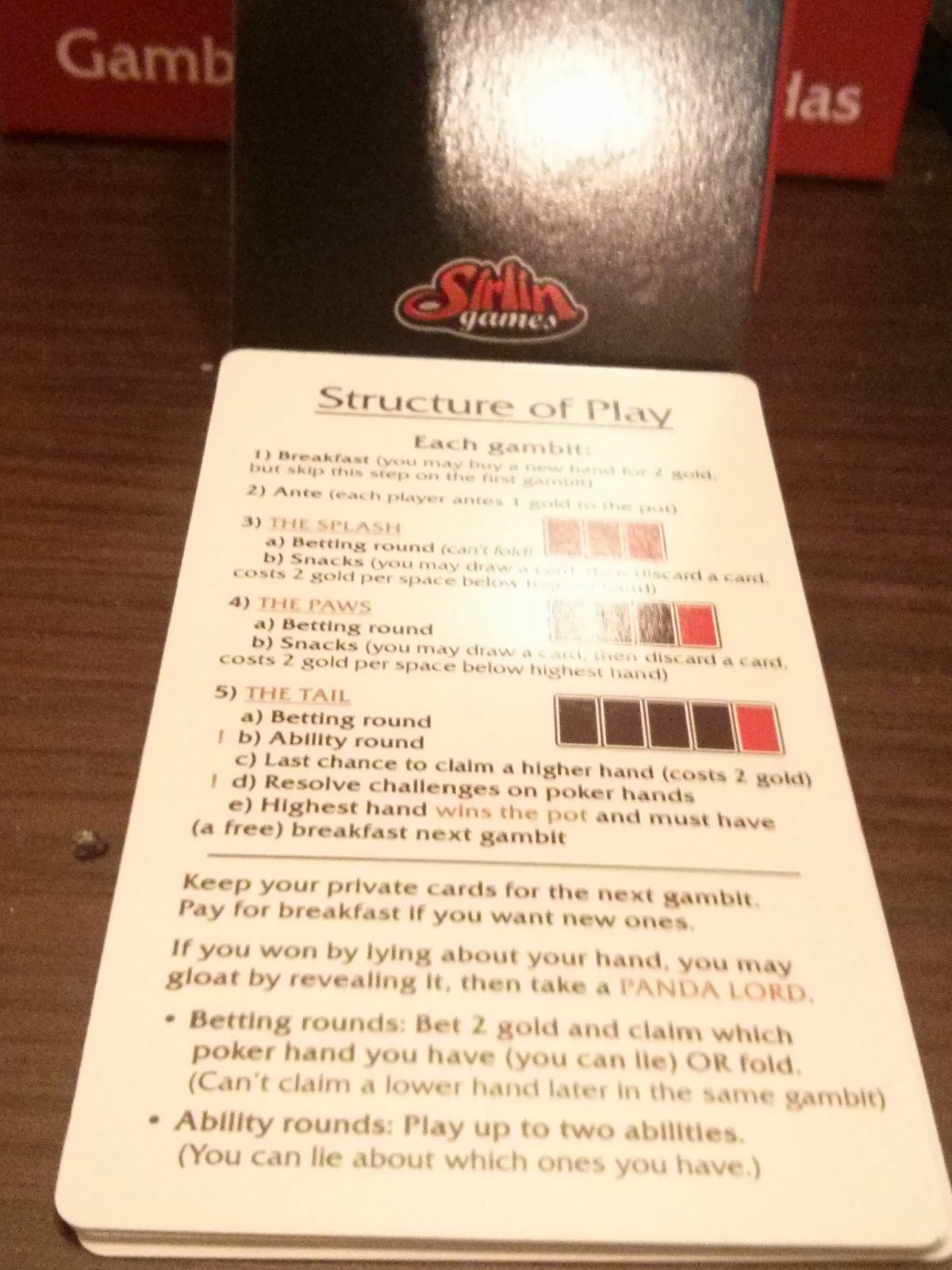
Structure of Play cards.


Like all good card games (that aren't wholly based on 'in game card rules' like Munchkin, fluxx and so on) Pandante comes with a structure of play card; a quick reference sheet on how the game plays out. There is enough for each player to have their own. Perfect.


Kickstarter Backer only rewards. 


I love and hate backer only rewards.
They are awesome if you're a backer, but if you're late to the party you miss out on them, which is a great shame.
The cards here are mainly to be switched with cards already in the core game, so it doesn't matter too much.
The purple card however has its own abilities. As does the alternate Orange Panda Lord.


The cards look pretty damn good.


There you have it!
I'm really looking forward to playing this.
If I'm honest I wish I had backed the deluxe edition which comes with high quality clay chips. It would have been nice to have the whole set.
Alas, I will have to settle for standard poker chips.

I really like how colourful the game is, and how devilishly simple it seems.
My only reservation is with the game play. The main draw of poker is the gambling aspect; the tension between the ultimate high of wining and the low of losing.
It will be interesting to see how Pandanté handles this. I know there is a way to 'buy back' into the game, so that should ease this problem.

I feel if it can make the game fun and fresh without relying on the gambling side of the game it will have done very well.


That is all for this issue.
Have you played Pandaté? What did you think?
What other Kickstarter board/card/RP games have you backed/played?

If you want to get in touch the please feel free to comment of hit me up @DarKHaZZl3 on twitter.
I'd love to hear from you.

Thanks for reading. See you soon!

-DH-